Freelance Video Editor New York: How To Build A Six-Figure Practice In Nyc's Creative Market
Discover how to thrive as a freelance video editor New York. Follow our complete guide to building a standout portfolio and landing your dream projects.
Insights
Jan 27, 2026
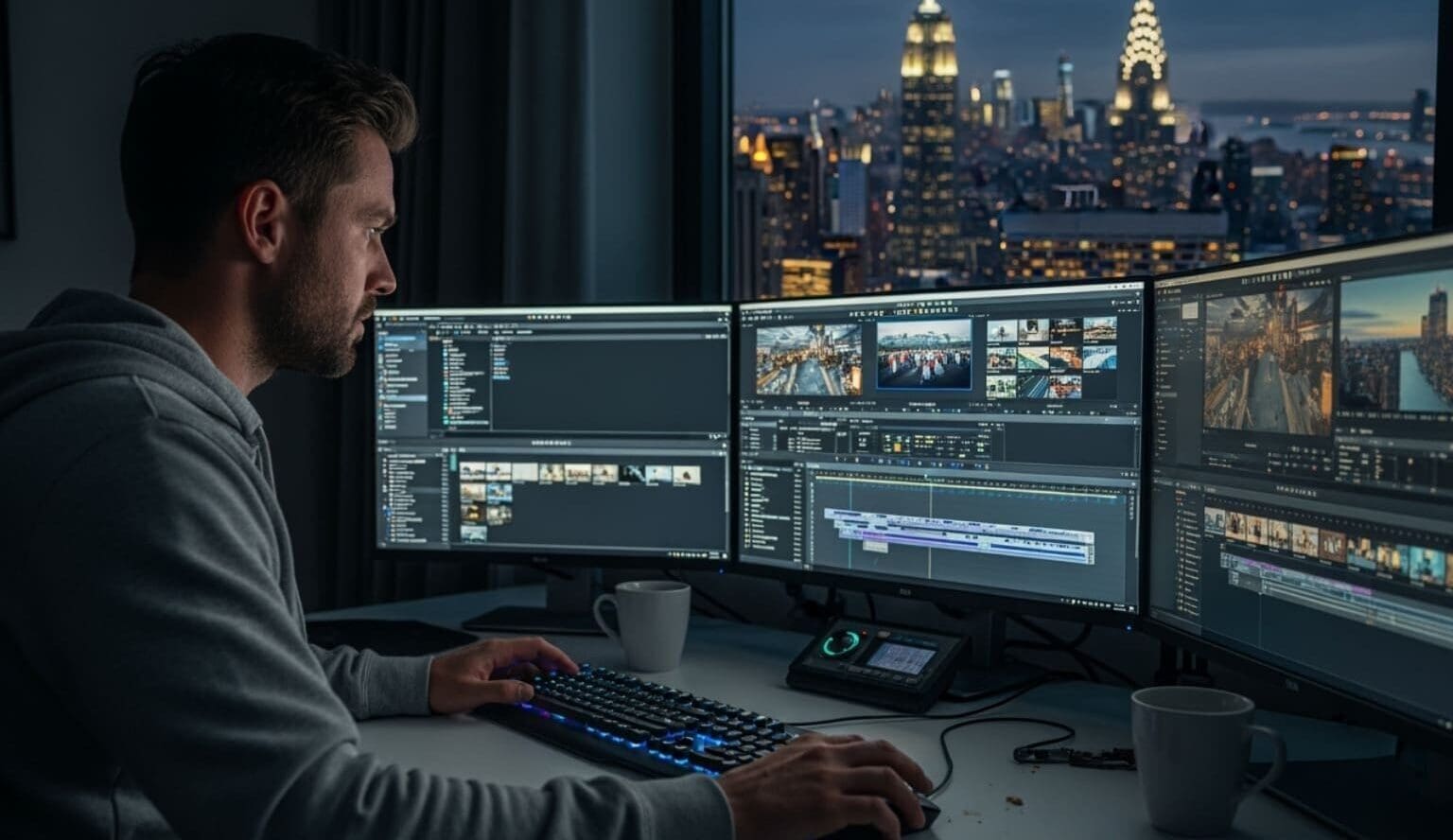
The NYC Freelance Video Editor Paradox
You're scrolling through job boards at midnight, watching "urgent video editor needed" posts pile up across Manhattan, Brooklyn, and Queens. Corporate presentations in Midtown, startup pitch videos in SoHo, restaurant promos in Williamsburg, luxury brand content on the Upper East Side. The demand is everywhere, yet your inbox stays quiet while rent gets closer.
This city produces more video content daily than almost anywhere else on earth, but breaking into sustainable freelance work feels like trying to get a table at a Michelin-starred restaurant without a reservation. The problem isn't lack of opportunity. It's that most editors approach the NYC market the same way: mass-applying to job posts, underpricing to compete, hoping someone notices their reel. Meanwhile, successful freelancers are building six-figure practices through systematic approaches that have nothing to do with job boards.
The difference between struggling and thriving isn't about better software skills or a flashier portfolio. It's about understanding how this city's creative ecosystem actually works. The unwritten rules about pricing. The relationship networks that generate referrals. The client segments that offer sustainable income versus one-off gigs. This guide walks you through the systematic approach that working freelancers use to build profitable practices in New York.

Master Your Technical Arsenal
Before you pitch a single client, answer one uncomfortable question: are your skills actually competitive for NYC's market? You might be proficient in Premiere Pro and think that's enough. But when a Manhattan law firm needs a partner spotlight video edited, color-graded, and delivered within six hours because their marketing director just remembered they're launching a campaign tomorrow, can you handle that pressure while maintaining the polished aesthetic they expect?
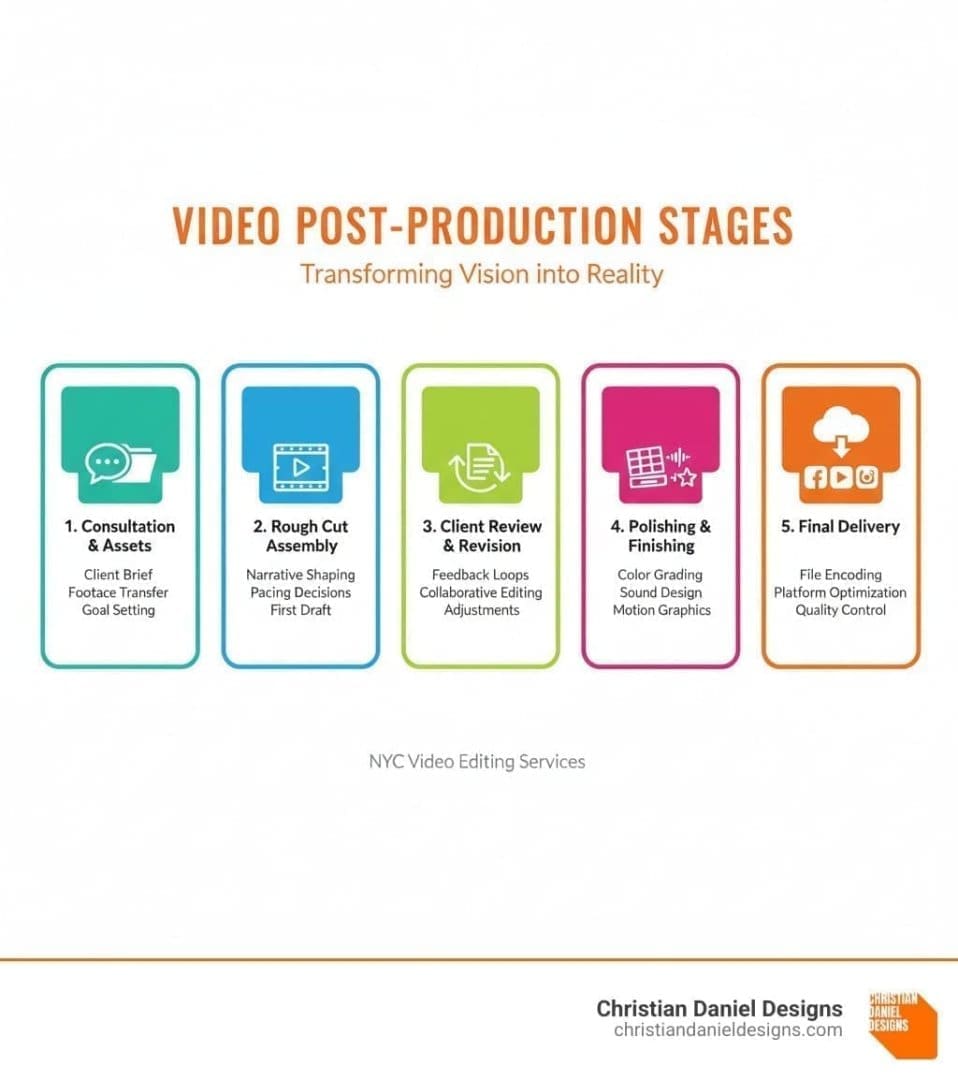
NYC clients operate on compressed timelines with elevated quality standards. They're not impressed that you know Adobe Creative Suite. They assume you've mastered it. What differentiates you is how quickly you can execute complex edits, how well you understand their industry's visual language, and whether your portfolio proves you can deliver what they need. Start with an honest skills audit. Open Premiere Pro and time yourself executing a complete edit workflow: importing footage, organizing bins, cutting a three-minute interview down to 90 seconds, color grading for consistency, mixing audio levels, and exporting in multiple formats. If this takes you more than 45 minutes, you're not fast enough for most NYC commercial work.
The software proficiency that matters here goes beyond basic editing. You need genuine expertise in After Effects for motion graphics and title animations because nearly every corporate video includes branded lower thirds and animated transitions. You need Audition skills for cleaning up audio recorded in less-than-ideal conditions, which describes about 60% of the footage you'll receive from small business clients. Color grading separates amateur work from professional results in this market. Luxury brands and corporate clients expect consistent, polished color that matches their brand guidelines.
But technical skills alone won't book clients. You need to translate those skills into business outcomes. Instead of saying "I'm proficient in Premiere Pro," your positioning should be "I deliver same-day turnarounds on corporate interview content with broadcast-quality color grading." One describes your tools, the other describes the client's result.
Build a Portfolio That Speaks to NYC
Your portfolio isn't just a collection of your best work. It's a strategic sales tool that needs to speak directly to the specific types of clients you want to attract in New York. The mistake most editors make is creating a generic reel that showcases technical skills without demonstrating understanding of what NYC businesses actually need.
Start by identifying 2-3 specific market segments you want to target. Maybe it's corporate clients in Midtown who need polished executive interviews and training videos. Or Brooklyn restaurants and retail shops that need social media content. Or creative agencies in SoHo that need motion graphics and brand videos. Your portfolio should include at least two strong examples for each target segment. If you're just starting and don't have paid client work yet, create spec projects that mirror real NYC business needs. Edit a mock corporate interview using stock footage. Create a restaurant promo for a real local business. Develop a social media campaign concept with multiple video variants.
What matters more than flashy effects is showing you understand the business context behind the video. For a corporate piece, that means demonstrating you can make executives look professional and authoritative. For restaurant content, it means proving you can make food look appetizing and capture the venue's atmosphere in 30 seconds. For agency work, it means showing you can execute a creative brief while maintaining brand consistency.
Technical presentation matters as much as content. Host your portfolio on a clean, fast-loading website with your own domain. Include brief context for each project: the client's goal, your role, and the results if possible. Organize your portfolio by industry or project type rather than chronologically. A corporate client doesn't want to scroll through wedding videos to find relevant work. Update your portfolio every 2-3 months as you complete stronger work. The goal isn't to show everything you can do. It's to show you can solve the specific problems your target NYC clients face.

Decode NYC's Multi-Layered Client Ecosystem
Here's what trips up most new freelancers: they treat the entire city as one giant market with one set of rules. A corporate law firm in Midtown, a Brooklyn coffee roaster, and a SoHo fashion startup all need video content, but they operate in completely different universes when it comes to budgets, timelines, communication styles, and what "professional quality" actually means.
The secret to sustainable freelance income in NYC isn't finding more clients. It's understanding which client segments align with your skills, rates, and working style, then positioning yourself strategically within those specific markets. Think of NYC's video editing market like the subway system. You wouldn't take the same train to get to Wall Street, Williamsburg, and the Bronx. Each destination requires a different route, and trying to serve all of them simultaneously leaves you exhausted and going nowhere.
Corporate Video in Manhattan's Business Districts: Financial services firms, law offices, consulting companies, and corporate headquarters need quarterly earnings presentations, internal training videos, executive interviews, and thought leadership content. These clients aren't just buying editing skills. They're buying risk mitigation. A poorly edited executive video that goes out to investors can have real consequences, which is why corporate clients pay premium rates for editors who understand business context and maintain absolute reliability. The corporate market typically pays $100-200 per hour or $1,500-5,000+ per project. Start by targeting mid-sized companies rather than Fortune 500 firms. A 200-person professional services firm in Midtown still has substantial video needs but fewer layers of bureaucracy.
Creative Agency Partnerships: New York's advertising and creative agencies regularly need freelance editors for overflow work, specialized projects, or when their staff editors are overbooked. Agency work typically pays $75-150 per hour. The trade-off for slightly lower rates than direct corporate work is higher volume and less client management. The agency handles client relationships while you focus purely on execution. You're essentially becoming an extension of their team, which means understanding their workflow systems and delivering exactly what their creative directors specify.
Small Business and Startup Opportunities: Brooklyn, Queens, and the Bronx offer a completely different client landscape. Small businesses, local restaurants, retail shops, and emerging startups need video content but operate on tighter budgets and faster timelines. These clients value personality and local understanding over corporate polish.
Navigate NYC's Creative Agency Network
Here's what most freelance video editors get wrong about agencies: they think of them as competitors when they should be viewing them as potential partners. Creative agencies across Manhattan, Brooklyn, and Queens are constantly juggling multiple projects with tight deadlines, and they need reliable freelancers who can step in without requiring hand-holding.
Agencies operate differently than direct clients. They're not hiring you to bring creative vision. They already have that from their in-house teams. They're hiring you to execute their vision flawlessly, match their established style guidelines, and deliver on time without drama. Your value proposition isn't "I can make your videos better." It's "I can extend your team's capacity without adding management overhead."
Building agency relationships requires a different networking approach than pursuing direct clients. Attend industry events where agency producers and creative directors gather, maintain an updated portfolio that shows you can execute various styles, and respond to initial inquiries faster than your competition. Once you prove reliable on a few projects, agencies will keep you on their preferred freelancer list for ongoing work. The workflow here differs significantly from direct client work. You'll typically receive detailed edit notes, work with their file organization systems, and deliver in specific formats for their approval process. Turnaround times are often compressed. Agencies frequently need edits completed in 24-48 hours when client feedback comes back late.
More to Discover


Freelance Video Editor New York: How To Build A Six-Figure Practice In Nyc's Creative Market
Discover how to thrive as a freelance video editor New York. Follow our complete guide to building a standout portfolio and landing your dream projects.
Insights
Jan 27, 2026
The NYC Freelance Video Editor Paradox
You're scrolling through job boards at midnight, watching "urgent video editor needed" posts pile up across Manhattan, Brooklyn, and Queens. Corporate presentations in Midtown, startup pitch videos in SoHo, restaurant promos in Williamsburg, luxury brand content on the Upper East Side. The demand is everywhere, yet your inbox stays quiet while rent gets closer.
This city produces more video content daily than almost anywhere else on earth, but breaking into sustainable freelance work feels like trying to get a table at a Michelin-starred restaurant without a reservation. The problem isn't lack of opportunity. It's that most editors approach the NYC market the same way: mass-applying to job posts, underpricing to compete, hoping someone notices their reel. Meanwhile, successful freelancers are building six-figure practices through systematic approaches that have nothing to do with job boards.
The difference between struggling and thriving isn't about better software skills or a flashier portfolio. It's about understanding how this city's creative ecosystem actually works. The unwritten rules about pricing. The relationship networks that generate referrals. The client segments that offer sustainable income versus one-off gigs. This guide walks you through the systematic approach that working freelancers use to build profitable practices in New York.
Master Your Technical Arsenal
Before you pitch a single client, answer one uncomfortable question: are your skills actually competitive for NYC's market? You might be proficient in Premiere Pro and think that's enough. But when a Manhattan law firm needs a partner spotlight video edited, color-graded, and delivered within six hours because their marketing director just remembered they're launching a campaign tomorrow, can you handle that pressure while maintaining the polished aesthetic they expect?
NYC clients operate on compressed timelines with elevated quality standards. They're not impressed that you know Adobe Creative Suite. They assume you've mastered it. What differentiates you is how quickly you can execute complex edits, how well you understand their industry's visual language, and whether your portfolio proves you can deliver what they need. Start with an honest skills audit. Open Premiere Pro and time yourself executing a complete edit workflow: importing footage, organizing bins, cutting a three-minute interview down to 90 seconds, color grading for consistency, mixing audio levels, and exporting in multiple formats. If this takes you more than 45 minutes, you're not fast enough for most NYC commercial work.
The software proficiency that matters here goes beyond basic editing. You need genuine expertise in After Effects for motion graphics and title animations because nearly every corporate video includes branded lower thirds and animated transitions. You need Audition skills for cleaning up audio recorded in less-than-ideal conditions, which describes about 60% of the footage you'll receive from small business clients. Color grading separates amateur work from professional results in this market. Luxury brands and corporate clients expect consistent, polished color that matches their brand guidelines.
But technical skills alone won't book clients. You need to translate those skills into business outcomes. Instead of saying "I'm proficient in Premiere Pro," your positioning should be "I deliver same-day turnarounds on corporate interview content with broadcast-quality color grading." One describes your tools, the other describes the client's result.
Build a Portfolio That Speaks to NYC
Your portfolio isn't just a collection of your best work. It's a strategic sales tool that needs to speak directly to the specific types of clients you want to attract in New York. The mistake most editors make is creating a generic reel that showcases technical skills without demonstrating understanding of what NYC businesses actually need.
Start by identifying 2-3 specific market segments you want to target. Maybe it's corporate clients in Midtown who need polished executive interviews and training videos. Or Brooklyn restaurants and retail shops that need social media content. Or creative agencies in SoHo that need motion graphics and brand videos. Your portfolio should include at least two strong examples for each target segment. If you're just starting and don't have paid client work yet, create spec projects that mirror real NYC business needs. Edit a mock corporate interview using stock footage. Create a restaurant promo for a real local business. Develop a social media campaign concept with multiple video variants.
What matters more than flashy effects is showing you understand the business context behind the video. For a corporate piece, that means demonstrating you can make executives look professional and authoritative. For restaurant content, it means proving you can make food look appetizing and capture the venue's atmosphere in 30 seconds. For agency work, it means showing you can execute a creative brief while maintaining brand consistency.
Technical presentation matters as much as content. Host your portfolio on a clean, fast-loading website with your own domain. Include brief context for each project: the client's goal, your role, and the results if possible. Organize your portfolio by industry or project type rather than chronologically. A corporate client doesn't want to scroll through wedding videos to find relevant work. Update your portfolio every 2-3 months as you complete stronger work. The goal isn't to show everything you can do. It's to show you can solve the specific problems your target NYC clients face.
Decode NYC's Multi-Layered Client Ecosystem
Here's what trips up most new freelancers: they treat the entire city as one giant market with one set of rules. A corporate law firm in Midtown, a Brooklyn coffee roaster, and a SoHo fashion startup all need video content, but they operate in completely different universes when it comes to budgets, timelines, communication styles, and what "professional quality" actually means.
The secret to sustainable freelance income in NYC isn't finding more clients. It's understanding which client segments align with your skills, rates, and working style, then positioning yourself strategically within those specific markets. Think of NYC's video editing market like the subway system. You wouldn't take the same train to get to Wall Street, Williamsburg, and the Bronx. Each destination requires a different route, and trying to serve all of them simultaneously leaves you exhausted and going nowhere.
Corporate Video in Manhattan's Business Districts: Financial services firms, law offices, consulting companies, and corporate headquarters need quarterly earnings presentations, internal training videos, executive interviews, and thought leadership content. These clients aren't just buying editing skills. They're buying risk mitigation. A poorly edited executive video that goes out to investors can have real consequences, which is why corporate clients pay premium rates for editors who understand business context and maintain absolute reliability. The corporate market typically pays $100-200 per hour or $1,500-5,000+ per project. Start by targeting mid-sized companies rather than Fortune 500 firms. A 200-person professional services firm in Midtown still has substantial video needs but fewer layers of bureaucracy.
Creative Agency Partnerships: New York's advertising and creative agencies regularly need freelance editors for overflow work, specialized projects, or when their staff editors are overbooked. Agency work typically pays $75-150 per hour. The trade-off for slightly lower rates than direct corporate work is higher volume and less client management. The agency handles client relationships while you focus purely on execution. You're essentially becoming an extension of their team, which means understanding their workflow systems and delivering exactly what their creative directors specify.
Small Business and Startup Opportunities: Brooklyn, Queens, and the Bronx offer a completely different client landscape. Small businesses, local restaurants, retail shops, and emerging startups need video content but operate on tighter budgets and faster timelines. These clients value personality and local understanding over corporate polish.
Navigate NYC's Creative Agency Network
Here's what most freelance video editors get wrong about agencies: they think of them as competitors when they should be viewing them as potential partners. Creative agencies across Manhattan, Brooklyn, and Queens are constantly juggling multiple projects with tight deadlines, and they need reliable freelancers who can step in without requiring hand-holding.
Agencies operate differently than direct clients. They're not hiring you to bring creative vision. They already have that from their in-house teams. They're hiring you to execute their vision flawlessly, match their established style guidelines, and deliver on time without drama. Your value proposition isn't "I can make your videos better." It's "I can extend your team's capacity without adding management overhead."
Building agency relationships requires a different networking approach than pursuing direct clients. Attend industry events where agency producers and creative directors gather, maintain an updated portfolio that shows you can execute various styles, and respond to initial inquiries faster than your competition. Once you prove reliable on a few projects, agencies will keep you on their preferred freelancer list for ongoing work. The workflow here differs significantly from direct client work. You'll typically receive detailed edit notes, work with their file organization systems, and deliver in specific formats for their approval process. Turnaround times are often compressed. Agencies frequently need edits completed in 24-48 hours when client feedback comes back late.
More to Discover
Freelance Video Editor New York: How To Build A Six-Figure Practice In Nyc's Creative Market
Discover how to thrive as a freelance video editor New York. Follow our complete guide to building a standout portfolio and landing your dream projects.
Insights
Jan 27, 2026
The NYC Freelance Video Editor Paradox
You're scrolling through job boards at midnight, watching "urgent video editor needed" posts pile up across Manhattan, Brooklyn, and Queens. Corporate presentations in Midtown, startup pitch videos in SoHo, restaurant promos in Williamsburg, luxury brand content on the Upper East Side. The demand is everywhere, yet your inbox stays quiet while rent gets closer.
This city produces more video content daily than almost anywhere else on earth, but breaking into sustainable freelance work feels like trying to get a table at a Michelin-starred restaurant without a reservation. The problem isn't lack of opportunity. It's that most editors approach the NYC market the same way: mass-applying to job posts, underpricing to compete, hoping someone notices their reel. Meanwhile, successful freelancers are building six-figure practices through systematic approaches that have nothing to do with job boards.
The difference between struggling and thriving isn't about better software skills or a flashier portfolio. It's about understanding how this city's creative ecosystem actually works. The unwritten rules about pricing. The relationship networks that generate referrals. The client segments that offer sustainable income versus one-off gigs. This guide walks you through the systematic approach that working freelancers use to build profitable practices in New York.
Master Your Technical Arsenal
Before you pitch a single client, answer one uncomfortable question: are your skills actually competitive for NYC's market? You might be proficient in Premiere Pro and think that's enough. But when a Manhattan law firm needs a partner spotlight video edited, color-graded, and delivered within six hours because their marketing director just remembered they're launching a campaign tomorrow, can you handle that pressure while maintaining the polished aesthetic they expect?
NYC clients operate on compressed timelines with elevated quality standards. They're not impressed that you know Adobe Creative Suite. They assume you've mastered it. What differentiates you is how quickly you can execute complex edits, how well you understand their industry's visual language, and whether your portfolio proves you can deliver what they need. Start with an honest skills audit. Open Premiere Pro and time yourself executing a complete edit workflow: importing footage, organizing bins, cutting a three-minute interview down to 90 seconds, color grading for consistency, mixing audio levels, and exporting in multiple formats. If this takes you more than 45 minutes, you're not fast enough for most NYC commercial work.
The software proficiency that matters here goes beyond basic editing. You need genuine expertise in After Effects for motion graphics and title animations because nearly every corporate video includes branded lower thirds and animated transitions. You need Audition skills for cleaning up audio recorded in less-than-ideal conditions, which describes about 60% of the footage you'll receive from small business clients. Color grading separates amateur work from professional results in this market. Luxury brands and corporate clients expect consistent, polished color that matches their brand guidelines.
But technical skills alone won't book clients. You need to translate those skills into business outcomes. Instead of saying "I'm proficient in Premiere Pro," your positioning should be "I deliver same-day turnarounds on corporate interview content with broadcast-quality color grading." One describes your tools, the other describes the client's result.
Build a Portfolio That Speaks to NYC
Your portfolio isn't just a collection of your best work. It's a strategic sales tool that needs to speak directly to the specific types of clients you want to attract in New York. The mistake most editors make is creating a generic reel that showcases technical skills without demonstrating understanding of what NYC businesses actually need.
Start by identifying 2-3 specific market segments you want to target. Maybe it's corporate clients in Midtown who need polished executive interviews and training videos. Or Brooklyn restaurants and retail shops that need social media content. Or creative agencies in SoHo that need motion graphics and brand videos. Your portfolio should include at least two strong examples for each target segment. If you're just starting and don't have paid client work yet, create spec projects that mirror real NYC business needs. Edit a mock corporate interview using stock footage. Create a restaurant promo for a real local business. Develop a social media campaign concept with multiple video variants.
What matters more than flashy effects is showing you understand the business context behind the video. For a corporate piece, that means demonstrating you can make executives look professional and authoritative. For restaurant content, it means proving you can make food look appetizing and capture the venue's atmosphere in 30 seconds. For agency work, it means showing you can execute a creative brief while maintaining brand consistency.
Technical presentation matters as much as content. Host your portfolio on a clean, fast-loading website with your own domain. Include brief context for each project: the client's goal, your role, and the results if possible. Organize your portfolio by industry or project type rather than chronologically. A corporate client doesn't want to scroll through wedding videos to find relevant work. Update your portfolio every 2-3 months as you complete stronger work. The goal isn't to show everything you can do. It's to show you can solve the specific problems your target NYC clients face.
Decode NYC's Multi-Layered Client Ecosystem
Here's what trips up most new freelancers: they treat the entire city as one giant market with one set of rules. A corporate law firm in Midtown, a Brooklyn coffee roaster, and a SoHo fashion startup all need video content, but they operate in completely different universes when it comes to budgets, timelines, communication styles, and what "professional quality" actually means.
The secret to sustainable freelance income in NYC isn't finding more clients. It's understanding which client segments align with your skills, rates, and working style, then positioning yourself strategically within those specific markets. Think of NYC's video editing market like the subway system. You wouldn't take the same train to get to Wall Street, Williamsburg, and the Bronx. Each destination requires a different route, and trying to serve all of them simultaneously leaves you exhausted and going nowhere.
Corporate Video in Manhattan's Business Districts: Financial services firms, law offices, consulting companies, and corporate headquarters need quarterly earnings presentations, internal training videos, executive interviews, and thought leadership content. These clients aren't just buying editing skills. They're buying risk mitigation. A poorly edited executive video that goes out to investors can have real consequences, which is why corporate clients pay premium rates for editors who understand business context and maintain absolute reliability. The corporate market typically pays $100-200 per hour or $1,500-5,000+ per project. Start by targeting mid-sized companies rather than Fortune 500 firms. A 200-person professional services firm in Midtown still has substantial video needs but fewer layers of bureaucracy.
Creative Agency Partnerships: New York's advertising and creative agencies regularly need freelance editors for overflow work, specialized projects, or when their staff editors are overbooked. Agency work typically pays $75-150 per hour. The trade-off for slightly lower rates than direct corporate work is higher volume and less client management. The agency handles client relationships while you focus purely on execution. You're essentially becoming an extension of their team, which means understanding their workflow systems and delivering exactly what their creative directors specify.
Small Business and Startup Opportunities: Brooklyn, Queens, and the Bronx offer a completely different client landscape. Small businesses, local restaurants, retail shops, and emerging startups need video content but operate on tighter budgets and faster timelines. These clients value personality and local understanding over corporate polish.
Navigate NYC's Creative Agency Network
Here's what most freelance video editors get wrong about agencies: they think of them as competitors when they should be viewing them as potential partners. Creative agencies across Manhattan, Brooklyn, and Queens are constantly juggling multiple projects with tight deadlines, and they need reliable freelancers who can step in without requiring hand-holding.
Agencies operate differently than direct clients. They're not hiring you to bring creative vision. They already have that from their in-house teams. They're hiring you to execute their vision flawlessly, match their established style guidelines, and deliver on time without drama. Your value proposition isn't "I can make your videos better." It's "I can extend your team's capacity without adding management overhead."
Building agency relationships requires a different networking approach than pursuing direct clients. Attend industry events where agency producers and creative directors gather, maintain an updated portfolio that shows you can execute various styles, and respond to initial inquiries faster than your competition. Once you prove reliable on a few projects, agencies will keep you on their preferred freelancer list for ongoing work. The workflow here differs significantly from direct client work. You'll typically receive detailed edit notes, work with their file organization systems, and deliver in specific formats for their approval process. Turnaround times are often compressed. Agencies frequently need edits completed in 24-48 hours when client feedback comes back late.